A Tiny Playbook: The 14-Day Proof Sprint
Davinia | Founder, Build From Abroad · 15 August 2025
Fourteen days will not prove that a business will succeed.
They can prove that your next large commitment is premature.
Too many diaspora businesses are built in the wrong order. We send money, buy stock, hire somebody and perhaps rent a shop before asking whether a reachable customer will pay for the offer.
I know because I have done it. Money gone, trust damaged, lessons learned the expensive way.
The 14-Day Proof Sprint is a short, controlled way to test one important assumption before you commit to stock, premises, staff or a large transfer. It is designed for diaspora founders who need evidence they can see from abroad.
First, choose one risky assumption
Do not try to validate the entire business in two weeks.
Choose the assumption that would make the plan fail even if everything else went well.
For example:
- Ten reachable customers will pay the proposed price.
- A local supplier can produce the agreed quality on time.
- Delivery can be completed inside the promised area without removing the margin.
- A Nigeria-based operator can run the process using a written handover.
- Customers who buy once will return within a realistic period.
Before beginning, use the L.A.G.O.S. Method to check whether the idea has a credible Local Pain, affordable offer, route to Growth, simple Operations and potential Stickiness.
Then write the decision the sprint must inform. Will you continue, adjust one part of the offer or stop?
Set the rules before seeing the result
Optimism becomes very creative after a disappointing test. That is why you set the thresholds first.
For a paid preorder test:
- Pass might mean six payments from 20 direct offers, with delivery completed at the expected margin.
- Adjust might mean three to five payments plus repeated objections to one fixable part of the offer.
- Stop might mean zero to two payments, or a delivery cost that makes the offer unworkable.
Your thresholds should fit the business. Their purpose is to stop you moving the goalposts after the result arrives.
A stopped test is not wasted money. It is a small amount protecting a much larger one.
Days 1–3: Define the test
Write the offer in one clear sentence.
Name the exact customer group. Set the price, test quantity, delivery area and closing date. Decide how people will pay and what they will receive.
Build only what the test needs. That may be a payment link, a sample photograph, a simple order form and a short operator checklist.
It does not need a perfect website, a new logo or enough packaging for customers who have not ordered.
Create one evidence sheet that records:
- people approached
- replies
- payments or deposits
- repeated objections
- refunds
- delivery outcomes
- complete costs
- founder and operator time
Keep the denominator. “Five sales” sounds strong until you discover that 2,000 people saw the offer. Two paid orders from 10 carefully selected buyers may reveal far more.
Days 4–7: Ask for action
Contact the customer group directly. Make the same clear offer to each person so the result is comparable.
Ask for the behaviour that matters.
If the assumption is willingness to pay, ask for payment or a deposit. If the assumption is supplier reliability, place a small real order with written specifications and a deadline. If the assumption is delivery, fulfil a limited number of genuine orders.
Compliments can help you improve the language. They cannot replace buyer action.
Record every response, including silence. Do not count likes from people who were never likely to buy.
Days 8–10: Deliver the promise
A payment proves only part of the business.
Now test whether you can fulfil what you sold.
Record the time from order to delivery, mistakes, customer questions, damaged items, refunds, operator decisions and every cost. Ask customers one focused question after delivery:
What nearly stopped you buying, or what would stop you ordering again?
If you are managing the test from abroad, test the reporting rhythm as well. Can the operator send the agreed evidence without being chased? Can they act inside clear decision limits?
Days 11–12: Change one variable
Review the strongest repeated objection or operating problem.
Change one meaningful variable, not the whole business.
You might adjust the portion size, collection window, delivery area, deposit amount or explanation of the offer. Keep the customer group and other major conditions steady where possible.
If everything changes at once, you will not know what caused the result.
Days 13–14: Reconcile and decide
Bring the evidence together.
How many people received the offer? How many replied? How many paid? What did fulfilment really cost? Which objection appeared repeatedly? Did the operator follow the agreed process? What changed because of the evidence?
Compare the result with the thresholds written on day one.
Pass means the evidence justifies the next controlled step. It does not justify immediate scale.
Adjust means one specific change deserves another small test.
Stop means the current version has not earned more money. Save the evidence. It may point you towards a better customer, offer or problem.
Protect the test from hidden subsidy
Early tests often appear profitable because somebody works for free, a relative absorbs delivery costs or the founder ignores their own time.
Record those contributions even when no cash changes hands.
The goal is to understand the real operating model, not manufacture a positive result.
A composite example
A founder wants to sell a limited collection of locally made home accessories to diaspora buyers visiting Lagos. Twenty carefully selected prospects receive a real offer for 10 preorder places.
Seven people pay. Six orders arrive on time. One item needs rework. Delivery and payment charges reduce the expected margin by 18 percent. Three non-buyers say the collection window is too narrow.
The sprint passes the demand threshold, but operations need adjustment.
The next move is not an order for 100 units. It is another small batch using the real margin, a wider collection window and a clearer quality check.
Buy the next decision
A useful sprint should leave you with one of three outcomes: increase the commitment carefully, change a specific part of the offer, or stop before the loss grows.
If the sprint merely made you feel busy, the test was too vague.
When the evidence supports moving forward, ROAM shows you how to build Routine, Oversight, Accountability and Metrics into the operation from the beginning.
Before the next transfer, ask: what is the smallest test that could produce evidence strong enough to change my decision?
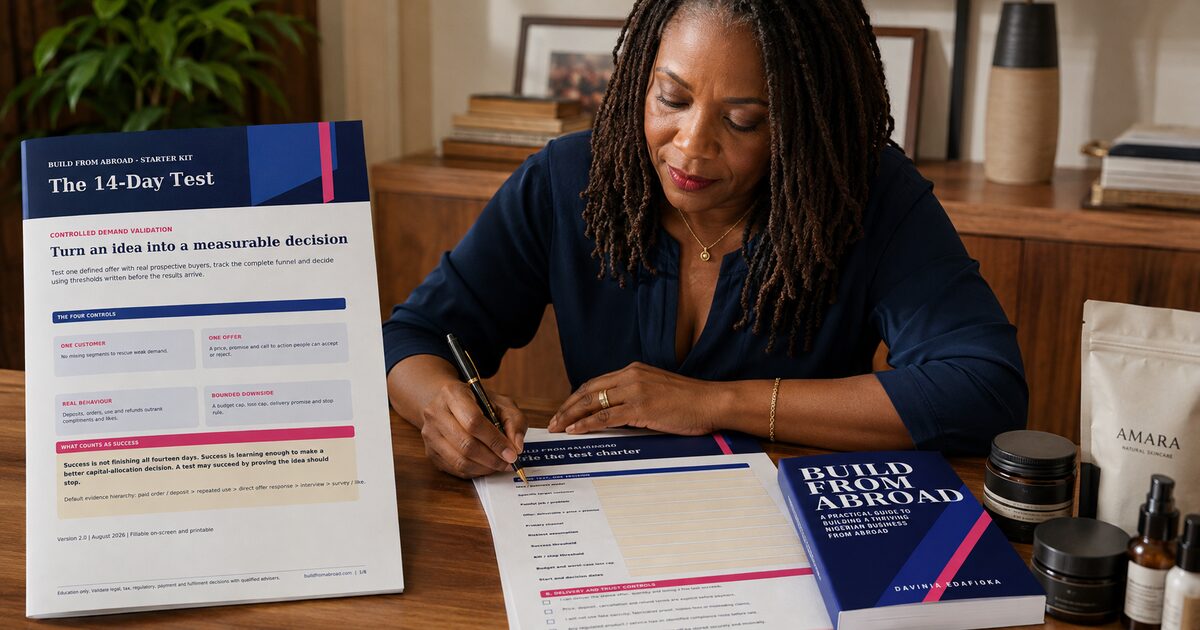
Download the free 14-Day Test Plan and define your assumption, thresholds and next move before day one.