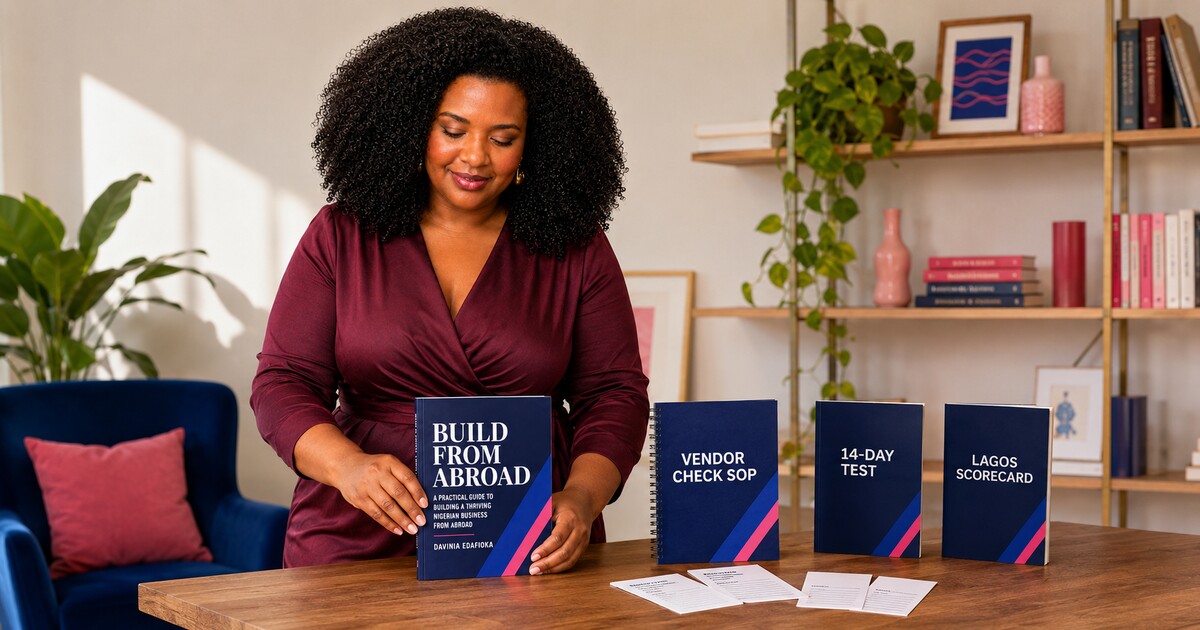
The L.A.G.O.S. Method in Plain Words
Davinia | Founder, Build From Abroad · 3 July 2025
A business idea can sound wonderfully convincing from abroad.
You hear that a market is growing. Friends say the product would sell. A relative knows somebody who can manage it. Before long, the conversation has moved from possibility to premises, stock and transfers.
The missing step is a disciplined check.
I learned that the expensive way. I once put thousands into the wrong idea. Money went, time went and the lesson arrived wearing steel-toe boots.
That is why I created the L.A.G.O.S. Method. It helps diaspora founders examine an idea through five practical questions: Local Pain, Affordability, Growth, Operations Simplicity and Stickiness.
It does not predict success. It exposes what you know, what you are assuming and what you need to test while changing direction is still affordable.
L = Local Pain
Forget passion for a moment. Start with pain.
Who experiences the problem often enough to act? What do they use now? What does the current solution cost them in money, time, inconvenience or risk?
“People need this” is not evidence. Look for behaviour: repeated complaints, current spending, awkward workarounds, waiting lists, deposits or requests for a specific solution.
Speak to at least five people in one reachable customer group. Ask what they did the last time the problem appeared. Past action usually tells you more than future enthusiasm.
A market can be busy and still have no room for your particular offer. Local Pain asks whether the problem is real, specific and urgent enough to make somebody change what they already do.
A = Affordability
A useful product can still fail at the wrong price.
Do not price from London, Toronto or Atlanta and assume the number will make sense in Lagos. Work out what the target customer currently pays, what they can realistically afford and what alternatives they can choose.
Affordability is not simply about making everything cheap. It is about matching price, value and the customer's cash reality.
Ask:
- What price can this customer pay without a long debate?
- Can the business deliver at that price and still retain a healthy margin?
- Would a smaller version, deposit or payment plan make the offer easier to test?
- Are you relying on customers being wealthier than the people you have actually spoken to?
If customers will buy only when the margin disappears, you have not solved the affordability problem.
G = Growth
Starting small is sensible. Staying dependent on one person, one street or one lucky introduction is risky.
Growth asks whether a working first sale can be repeated.
Can you reach the next 20 customers through the same route? Can a supplier maintain quality when the order doubles? Does delivery become cheaper or more complicated? Does every new customer create useful margin, or simply create more work?
Do not award a high Growth score because Nigeria has a large population. Population is possibility. Growth needs a repeatable path from one satisfied customer to the next.
O = Operations Simplicity
Running a business in Nigeria from abroad already adds distance, delayed decisions and limited visibility. An idea with 20 moving parts makes those risks worse.
Who receives stock? Who checks quality? Who handles complaints? Which decisions can the Nigeria-based operator make without waiting for you? What proof will you see each week?
A strong idea should be understandable on one page. It should have clear roles, a manageable supplier chain, a simple fulfilment process and evidence that can be reviewed remotely.
Operations Simplicity does not mean the work is effortless. It means the system is clear enough to run without the founder becoming the answer to every question.
S = Stickiness
The strongest businesses give customers a reason to return.
Does the need happen once, occasionally or every week? Will customers reorder because the offer remains useful, or will you need to win the same sale from the beginning every time?
Look for natural repeat behaviour: replenishment, subscriptions, maintenance, ongoing service, referrals or a product that becomes part of a routine.
Do not confuse aggressive follow-up with Stickiness. The customer should return because the value continues, not because the business keeps begging.
A composite example
Imagine a UK-based founder considering a healthy snack delivery service for office workers in Lagos. Friends like the samples and the addressable market looks huge.
Local Pain scores 3 out of 5. Office workers already buy convenient snacks, but the founder has interviewed only friends.
Affordability scores 2. The proposed price reflects UK-style packaging, and nobody in the target office cluster has paid it.
Growth scores 3. Repeat office delivery may work, although the founder has not tested how the first 20 customers will be acquired.
Operations Simplicity scores 2. One relative is expected to receive stock, coordinate delivery and report cash without a written role.
Stickiness scores 3. Weekly repeat orders are plausible, but there is no reorder evidence yet.
The score does not say “never”. It says the next move is not a large stock order. The next move is a small paid test with one office cluster, a limited batch and a complete record of costs and customer responses.
How to use your score
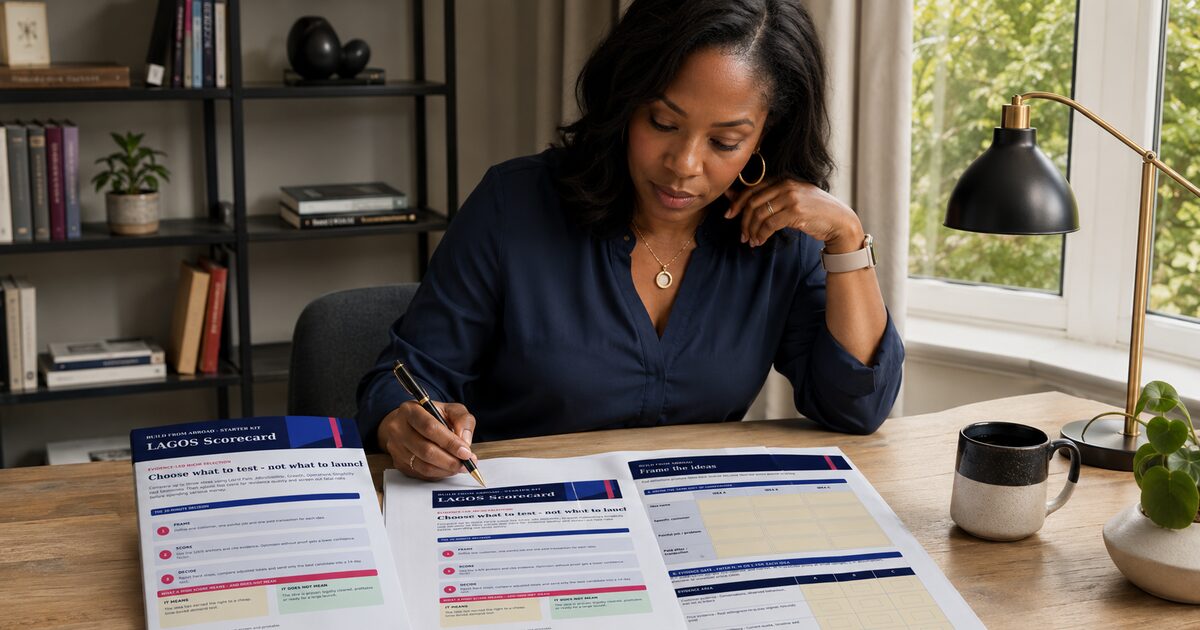
Score each area from 1 to 5 and write the evidence beside it.
A low score is not a failure. It tells you what to test next.
If Local Pain is weak, interview buyers and examine what they already do. If Affordability is weak, ask for payment at the proposed price. If Growth is weak, prove one repeatable acquisition route. If Operations Simplicity is weak, rehearse the handover and reporting process. If Stickiness is weak, test whether the first customers return.
Do not average away a serious weakness. Strong demand cannot rescue an operation you cannot control. Simple operations cannot create demand that does not exist.
A promising score is a reason to test, not permission to launch.
Your next step is the 14-Day Proof Sprint, where real potential customers show interest through action rather than compliments. If the evidence earns a larger move, use the ROAM framework to make the operation visible from abroad.
The purpose of L.A.G.O.S. is not to make every idea look investable. It is to make your next decision clearer.
Because the goal is not just profit. It is Profit + Peace.
Download the free L.A.G.O.S. Scorecard, score one live idea and choose the smallest test that could change your mind.