Why a Good Business Framework Still Fails Without Implementation
Davinia | Founder, Build From Abroad · 27 September 2026
A good business framework can give you the right questions and still leave the business unchanged.
That is not because the framework failed. It is because understanding a method and implementing it are different jobs.
From abroad, that gap becomes wider. You hear that a market is growing. Friends say the product would sell. A relative knows somebody who can manage it. Before long, the conversation has moved from possibility to premises, stock and transfers.
You may know that you should test the plan, but still lack the rhythm, evidence standard or accountability needed to complete the test.
The L.A.G.O.S. Method helps you examine an idea through five practical questions: Local Pain, Affordability, Growth, Operations Simplicity and Stickiness.
It does not predict success. It exposes what you know, what you are assuming and what you must test while changing direction is still affordable.
But the scorecard is the beginning, not the finish line. Every weak answer needs to become a specific test. Every test needs a deadline and an evidence threshold. Then the result must change a real decision.
The implementation gap
Most founders do not need another long list of things they could do. They need three disciplines.
1. Choose one decision
“Work on the business” is too broad.
Decide whether you are testing the buyer, price, operator, supplier, margin or remote-control system. One real decision gives the work a boundary and makes it possible to finish.
2. Name the proof
Compliments, activity and reassuring updates can all feel like progress. Decide what can be independently checked: payment, delivery time, stock count, cost record, customer return or a completed handover.
“Everybody liked it” is not the same as “six people paid at the proposed price.” The second result can guide an investment decision.
3. Set the review
Evidence that is never reviewed cannot improve the plan.
Put a date in the diary. Decide in advance what will make you proceed, adjust or stop. Otherwise, it is too easy to move the goalposts when the result is disappointing.
How L.A.G.O.S. becomes weekly action
Choose the lowest or least certain part of your L.A.G.O.S. score.
- Write one assumption beneath it.
- Design one small action that could disprove the assumption.
- Decide what evidence you will accept.
- Review the result within seven days.
- Choose whether to proceed, adjust or stop.
If Local Pain is uncertain, speak to reachable buyers and examine what they already do when the problem appears.
If Affordability is weak, ask for payment at the proposed price rather than asking whether people like the idea.
If Growth is unclear, prove one repeatable route to the first 20 customers before planning for thousands.
If Operations Simplicity is weak, rehearse the handover, decision limits and reporting process before appointing somebody to run the business.
If Stickiness is uncertain, measure whether first customers return without being chased into another purchase.
A low score is not a failure. It tells you where the next useful test belongs.
The framework should change the investment
Imagine a UK-based founder considering a healthy snack delivery service for office workers in Lagos.
Friends like the samples and the addressable market looks huge. But nobody in the intended office cluster has paid the proposed price. One relative is expected to receive stock, coordinate deliveries and report cash without a written role. Repeat orders are possible, but have not been tested.
The framework does not say “never”. It says the next move is not a large stock order.
The next move is a small paid test with one office cluster, a limited batch, a complete cost record and a written handover. That test should reveal whether the price works, whether the delivery promise survives and whether the operator can complete the process without constant founder intervention.
The framework has become useful because it changed what happens next.
Guidance is valuable when it helps you finish
There is no prize for collecting the most templates, attending the most classes or producing the thickest business plan.
The real test is whether the work creates a clearer decision.
That is the difference between collecting business advice and building a decision system.
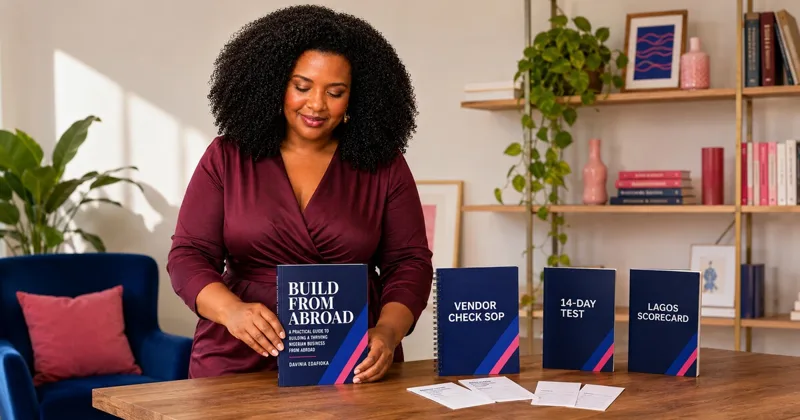
The Build From Abroad Business Lab is for founders who want help doing that work. Over six guided weeks, you apply the method to one real Nigerian business, review the evidence and turn the decisions into a practical 90-day roadmap.
The website explains the programme. The more important question is whether guided implementation would help you finish the work your business now requires.
Explore the Business Lab and see whether the founding cohort fits your situation.
Because the goal is not simply to know more. It is to make better decisions with Profit + Peace.