How to register a Nigerian business from abroad: a CAC guide for diaspora founders
Davinia | Founder, Build From Abroad · 5 November 2026

You don't need to fly home to register a business in Nigeria. Registration with the Corporate Affairs Commission (CAC) is done online, and Nigerians in the UK, US, Canada and elsewhere register from abroad every day.
The form is the easy part. Two earlier decisions matter more, and both are easy to get wrong from a distance: which structure you register, and which identity you register with.
Checked November 2026. Rules, fees and portal steps change, so confirm current requirements before you file.
1. Do you need to register at all?
Under Nigeria's Companies and Allied Matters Act 2020 (CAMA), it is an offence to carry on business as a company, partnership or under a business name without registering with the CAC. In April 2025 the CAC publicly restated this and reminded companies to display their registered name and number wherever they trade.
If you trade only under your own full name, with nothing added, CAMA does not require a business name registration. Most diaspora founders want a brand name, a business bank account or a company, so in practice most will register.
2. Business name or limited company?
A business name (an "enterprise") is the simplest option. It lets you trade under a name other than your own. It is not a separate legal person: you and the business are the same in law, so debts and claims can reach you personally. A business name must file an annual return with the CAC by 30 June each year, except in the year it was registered.
A private limited company (Ltd) is a separate legal person. Your liability is generally limited to what you put in. Since CAMA 2020, one person can form a private company, acting as both director and shareholder. The minimum issued share capital for a private company is ₦100,000. Companies file annual returns every year and keep company records.
As a rough guide:
- Testing a small idea with little at stake: a business name may be enough, or it may be too early to register at all.
- Hiring staff, signing leases or contracts, taking larger risks, or bringing in partners or investors: a limited company is usually the better fit.
- Expecting to grow or sell the business later: starting as a company avoids converting later.
3. Your identity: the most important diaspora question
If you are registering as a Nigerian, you need a National Identification Number (NIN). The CAC made the NIN mandatory for Nigerian directors, shareholders and business name owners, and your details on the portal must match your NIN record. If you don't have one, the National Identity Management Commission (NIMC) runs NIN enrolment for Nigerians abroad through licensed partners, including centres in the UK. Allow time for this before you start.
If you register with a foreign passport, or have a foreign co-founder, spouse or investor on the company, the company is treated as having foreign participation. In current practice, that means a minimum share capital of ₦100 million, registration with the Nigerian Investment Promotion Commission (NIPC) and a business permit. That is a very different cost and timeline.
If you are a dual citizen, decide which identity you will use before you file, and take advice. The difference can run to tens of millions of naira in share capital, plus extra stamp duty and filings.
4. You will need a Nigerian address
The business needs an address in Nigeria. For a company, that is its registered office. Choose an address you can trust to receive official letters, and agree in writing who checks the post and forwards anything important to you.
5. What to prepare
For a business name:
- two or three proposed names, in order of preference
- a specific description of what the business does (vague descriptions such as "general contracts" are often rejected)
- the business address in Nigeria and your residential address
- your NIN, plus a valid ID, a passport photograph and a signature, in the formats the portal asks for
- an email address and phone number you check
For a private limited company, everything above, plus:
- details of each director and shareholder, and how many shares each holds
- the issued share capital, at least ₦100,000
- the memorandum and articles of association (the CAC provides a standard version)
- details of any person with significant control, meaning anyone who ultimately owns or controls the company
6. How the online process works
1. Create an account on the CAC's online registration portal.
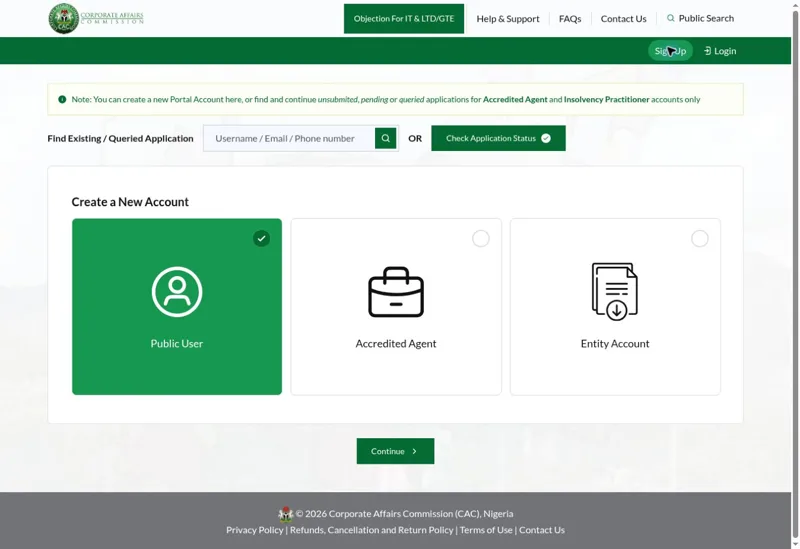
CAC sign-up screen. Public User is the option shown for individuals creating an account. Screenshot captured 5 November 2026.
2. Search for name availability and reserve your preferred name.
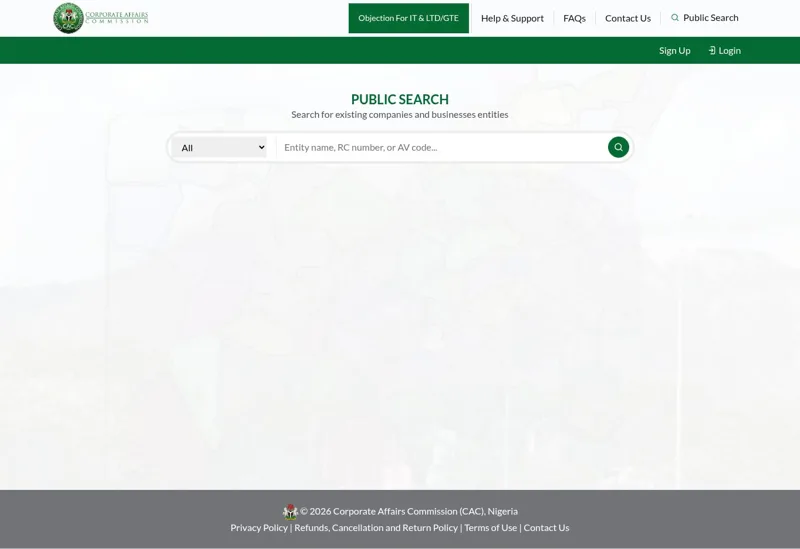
Use the CAC Public Search to look up existing entities. Reserve your chosen name through the registration portal. Screenshot captured 5 November 2026.
3. Complete the registration form for a business name or a company.
4. Upload your documents and pay the fees online.
5. Once approved, download your certificate. A business name receives a BN number; a company receives an RC number.
Straightforward applications can be quick. Name queries, mismatched NIN details and rejected documents are the usual causes of delay, so check every detail matches before you submit.
7. What it costs
Official CAC fees depend on the structure and, for a company, on the share capital. Companies also pay stamp duty on their share capital. Agent or professional fees are separate, and some providers advertise a single price that hides which part is official.
Don't budget from an old headline figure. Ask for an itemised quote that separates official charges, stamp duty and professional fees.
8. Doing it yourself, or using an agent
You can file yourself on the portal. Many people use an accredited agent or a lawyer, especially from abroad. If you do, protect your control:
- make sure you are named as the owner, director and shareholder, not the agent or a relative "for convenience"
- keep the portal login, or get it handed over at the end
- receive the certificate and status report directly
- check the result yourself on the CAC's public search
A registration in someone else's name is one of the hardest problems to undo from abroad.
9. After the certificate
Registration is the start of compliance, not the end. Plan for:
- Display: show the registered name and number at your premises and on invoices, letterheads and your website.
- Bank account: opening a business account usually needs your BVN and the registration documents. Each bank sets its own requirements for directors abroad.
- Tax: register for the right taxes and get an accountant early. Tax registration is separate from CAC annual returns.
- Annual returns: file every year. Business names file by 30 June. Missed returns lead to penalties and, eventually, removal from the register.
- Records: keep your significant-control information and director details up to date.
- Sector permits: food, drink, cosmetics, health, finance and other regulated activities often need approvals beyond CAC registration.
10. Is now the right time to register?
Registration makes a business official. It does not prove anyone will buy from it. If you are still testing an idea, a small paid test may tell you more than a certificate, and it is cheaper to change a plan before you have a company to maintain. Our free 14-Day Test Plan shows how.
Need help registering?
You can ask us for registration on its own, with no assessment first. We scope what you need, coordinate it with the relevant specialist in Nigeria and quote it separately, with official charges shown apart from professional fees. Ask about registration support.
If you are deciding between a business name and a company, or whether to register yet, a Business Decision Session can help you choose.
Related guides
Sources
- Corporate Affairs Commission: registration portal and public search
- CAC public notice on carrying on business under an unregistered name, April 2025 (Nairametrics) and Templars regulatory update
- CAMA 2020: share capital requirements (Pavestones Legal, Mondaq)
- CAC makes NIN compulsory for business registration (Nairametrics)
- NIMC diaspora NIN enrolment platform (Nairametrics) and National Identity Management Commission
- Registering a foreign-owned company in Nigeria (The Trusted Advisors, Legal 500)
- Annual returns under CAMA 2020 (Mondaq)
This is general guidance for founders, not legal or tax advice. Build From Abroad is not a law firm. Confirm your position with a qualified Nigerian professional before you register.